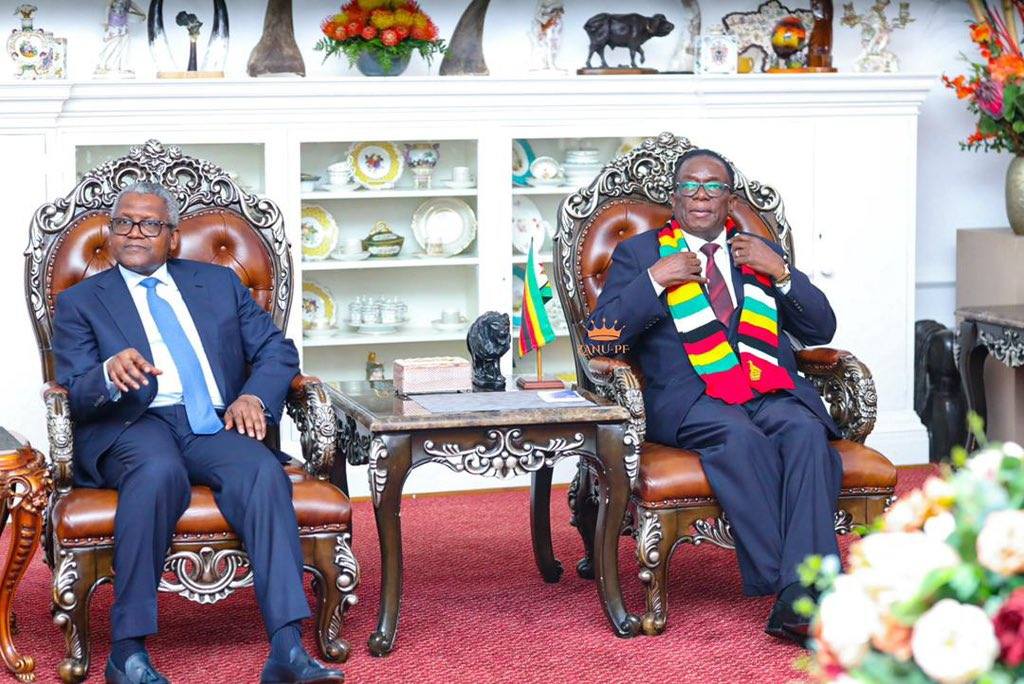
When Aliko Dangote landed in Harare on 12 November 2025, it was more than a return visit; it felt like destiny finally catching up. The Nigerian industrial titan, Africa’s richest man, came back to Zimbabwe not simply to tour, but to seal what could be one of the country’s largest-ever private-sector investments. A decade earlier, his ambitions had stalled. This time, the stage was different, and so was the script.
Dangote’s arrival was no secret. Reports from Zimbabwean media outlets in the weeks leading up to his trip spoke of a US$1 billion deal in the making, covering cement, coal mining, and power generation. For a country long hungry for industrial revival, the scale of commitment was breathtaking. State officials carefully arranged a welcome: he was received not just by senior bureaucrats but by none other than President Emmerson Mnangagwa himself, underscoring how high the stakes were.
At a highly publicized signing ceremony in State House, Dangote laid out the plan: “We have just signed an agreement … to undertake various investments across several sectors including cement, power generation, and petroleum products,” he told journalists, flanked by Zimbabwean Finance Minister Mthuli Ncube. The scale of the project was formidable, a fully integrated industrial complex that would include a cement factory with its own limestone quarry and grinding plant, a coal mine, and a power station.
Yet the vision stretched even further. According to Deputy Chief Secretary for Presidential Communications George Charamba, the deal also includes a transnational oil pipeline running from Walvis Bay in Namibia, across more than 2,200 kilometres to Zimbabwe. In his words, this is not just about building factories—it’s about reconfiguring regional infrastructure. The pipeline would land in Bulawayo and continue to Harare via Gweru, inserting Zimbabwe into Dangote’s ambitious southern Africa energy network.
For Mnangagwa’s government, the timing could not be better. The deal aligns neatly with his Vision 2030 national development plan to industrialize Zimbabwe and create jobs. Presidential Investment Advisor Dr. Paul Tungwarara, who helped facilitate the engagement, spoke of the visit as a long-awaited opportunity: “We are now handling the final logistical preparations … to ensure this engagement leads to tangible, long-term investment,” he said, underscoring that this time, the government was personally invested in turning talks into delivery.
Dangote himself was candid about why he chose Zimbabwe now. Reflecting on his unsuccessful previous attempts in 2015 and 2018, he said: “There’s been quite a lot of change between when we came and now. The government is solid … When you look at what His Excellency has done in turning the economy around, that gave us the confidence … this is the right time for us to come and invest.” He framed his return as a form of national examination: “When you pass an exam … people have to come and give you a good mark. His Excellency has passed that exam … that’s why we’re here … to give him a very big mark.”
The deal, as laid out, promises tangible benefits for Zimbabwe—perhaps even transformative ones. The cement factory could reduce Zimbabwe’s dependence on imports, saving the country millions annually and feeding into its massive reconstruction needs. The power plant, powered by coal, could contribute to easing the country’s chronic energy shortages. And the pipeline, if built, would not only secure product flow but also embed Zimbabwe into a broader southern African energy corridor.
One of the more unexpected but critical parts of the agreement is in fertilisers. Zimbabwean officials note that Dangote recognizes the country’s agricultural potential and sees investment in fertiliser production as a way to support regional food security. By helping strengthen agribusiness, this deal could boost Zimbabwe’s export competitiveness and potentially create ripple effects through rural economies.
Behind the scenes, the deal was carefully orchestrated. Local business facilitators played a major role. Journalist-turned-investment broker Josephine Mahachi who was involved in Dangote’s earlier attempt emerged as a key intermediary. She described her role as “humbling,” adding that the renewed engagement involved direct dialogue with State House through Tungwarara. Financial advisory firm Bard Santner Markets Inc., led by CEO Senziwani Sikhosana, backed the negotiations, showing how Zimbabwe’s financial sector is leaning into industrial diplomacy.
Not everyone is blind to the risks, though. Skeptics note that Dangote’s earlier Zimbabwe forays fell apart under unclear conditions. In 2015, for instance, what appeared to be a concrete deal to develop coal-fired power collapsed amid reports of bureaucratic delays and a lack of cost-reflective tariffs. There remains a question of whether this time, the structures will hold up once the grand vision meets ground reality.
Yet, for many Zimbabweans, Dangote’s presence represents a vote of confidence, not only in the Zimbabwean economy, but in Mnangagwa’s ability to deliver real change. “The richest man in Africa is coming to Zimbabwe at the personal invitation of President Mnangagwa … We are keen to ensure that he makes a significant investment … and avoid what happened during his previous visit,” advised Tungwarara. If Dangote fulfills even half his vision for Zimbabwe, it could herald a new era: industrial growth, energy security, and real jobs. But for now, the world watches as signs become contracts and contracts, if kept, become legacy.
Source: PAV Magazine